The Benefits Of Using Metal Garden Edging In Modern Landscape Designs
Table of Contents
- Why Garden Edging Matters More Than Most People Realise
- The Material Advantage: Why Metal Outperforms Other Options
- How Metal Edging Supports Contemporary Landscape Aesthetics
- Practical Installation Considerations
- Longevity and Return on Investment
- Environmental Considerations
- Working with a Landscape Supplies Provider to Get It Right
- Getting the Most From Your Metal Edging Investment
- Ready to Start Your Next Landscape Project?
There's a particular kind of frustration that comes with a garden that looks great in late winter and completely dishevelled by Christmas. You've laid the mulch, planted the natives, even edged the beds with a spade — and within a season, grass is creeping in, gravel is migrating onto the lawn, and the clean line you worked hard to achieve has quietly disappeared.
For homeowners, landscape designers and property managers alike, metal garden edging has become the practical solution to this very common problem. It's not a trend. It's a structural decision that shapes how a landscape holds together. Whether you're sourcing landscape supplies in Nowra for a new build or refreshing an established garden, understanding the full value of metal edging will help you make a more informed investment.
Why Garden Edging Matters More Than Most People Realise
Edging doesn't just make a garden look tidy — it defines the entire spatial logic of a landscape design. Without it, the boundaries between planting beds, turf, pathways and feature areas become soft and ambiguous. Over time, that ambiguity creates maintenance problems: roots encroach, mulch shifts and mowing becomes more complicated.
Metal garden edging creates a defined, structural boundary that does its job quietly and consistently. Unlike timber or plastic alternatives, it doesn't rot, warp, crack or fade. It simply holds its position. That physical reliability translates into a landscape that retains its intended layout far longer, reducing the frequency and cost of ongoing maintenance.
Key reasons edging is worth prioritising in any landscape plan:
- It creates clear separation between zones — lawn, garden beds, pathways and feature areas
- It reduces the labour involved in maintaining clean lines over time
- It provides a structural anchor for loose materials like gravel, bark and decomposed granite
- It supports the overall cohesion of a landscape design by reinforcing intentional boundaries
Plastic edging has its place in short-term or low-budget applications, but it has genuine limitations. It becomes brittle in UV-intense conditions, flexes unevenly with soil movement and rarely holds a clean line over multiple seasons. Timber edging has an organic appeal but requires treatment, eventual replacement and is susceptible to termites in certain climates.
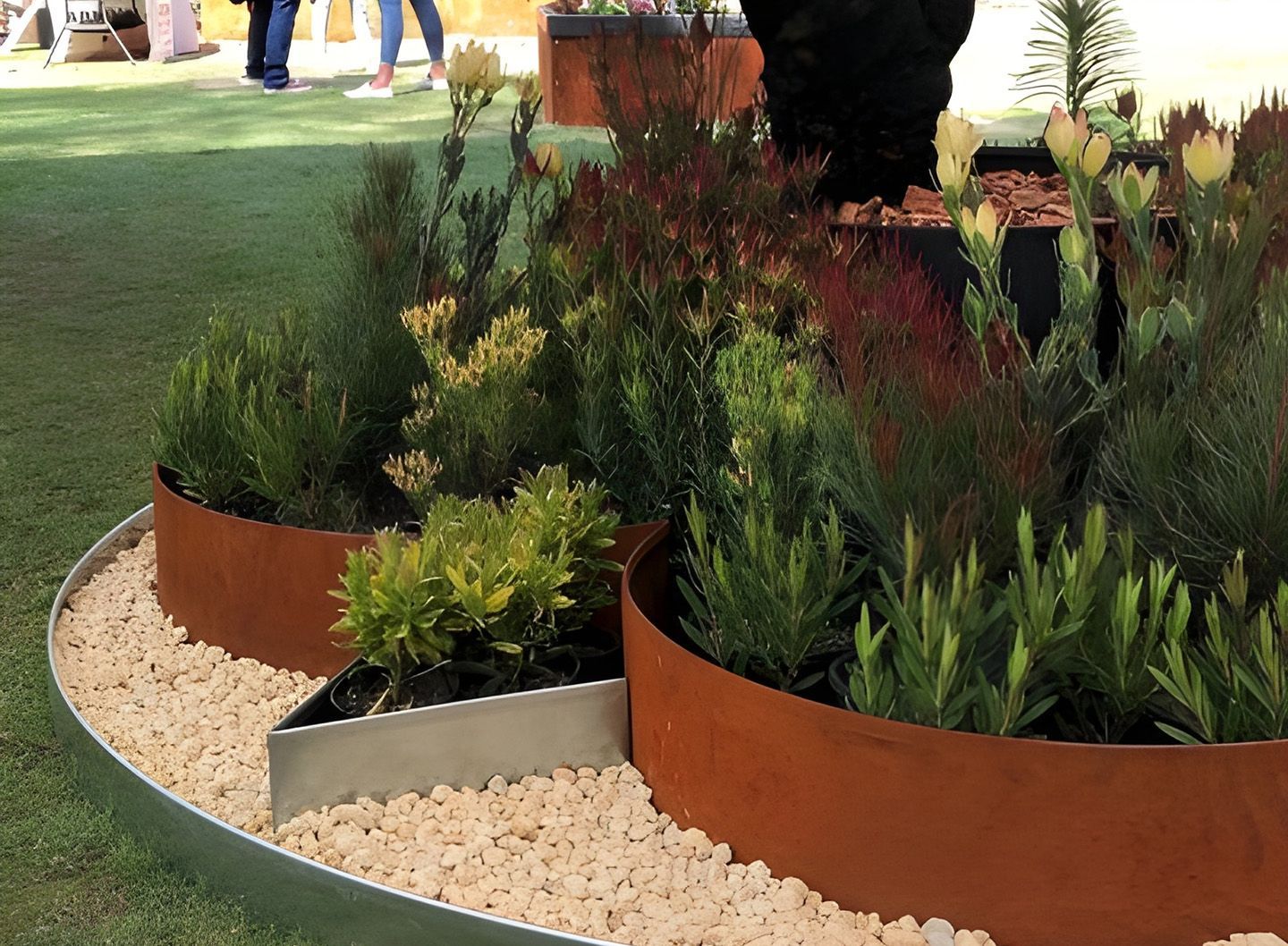
Metal garden edging — particularly Corten steel and powder-coated steel — offers a different performance profile. It's physically rigid, maintaining its form even in heavy clay soils or on sloped sites. It's resistant to UV degradation, soil acids and moisture. And it's thin enough to be unobtrusive while being strong enough to handle edging trimmers, garden forks and the general contact of routine maintenance.
Material considerations worth comparing:
- Corten steel: Develops a natural oxide layer that protects the underlying metal and gives an earthy, warm tone that complements native and native-style planting.
- Powder-coated steel: Available in a range of colours, offering a more tailored aesthetic for contemporary or formal garden styles.
- Galvanised steel: Provides long-term corrosion resistance in wet or coastal environments where moisture exposure is frequent.
Modern landscape design has shifted significantly over the past decade. Clean geometry, restrained planting palettes and a preference for low-maintenance materials have all become central to how residential and commercial landscapes are designed. Metal edging fits naturally into this context.
Its slim profile allows it to create crisp, precise lines without visually dominating the landscape. It works equally well in curves and straight runs, supporting both the organic fluidity of naturalistic designs and the sharp geometry of minimalist outdoor spaces. When paired with quality landscape supplies, metal edging gives those materials a well-defined frame to sit within.
Design contexts where metal edging performs particularly well:
- Feature garden beds around architectural homes with clean, contemporary lines
- Gravel or pebble pathways where containment of loose material is essential
- Sloped or tiered gardens where structural definition helps manage soil movement
- Turf-to-garden transitions where a clear boundary prevents ongoing maintenance issues
Practical Installation Considerations
One of the most underestimated aspects of metal garden edging is how its success depends on correct installation. Even a premium product will underperform if it's installed without proper ground preparation, adequate depth or appropriate anchor staking.
The standard approach involves setting the edging so that the top sits slightly above the lawn surface — enough to act as a physical barrier to runners, but not so high that it becomes a hazard or visual distraction. On curved sections, the edging should be pre-bent gradually rather than forced, which prevents kinking and maintains a smooth, even arc.
Practical points to confirm before installation:
- Depth: At least 50mm below soil surface to prevent grass runners from tunnelling underneath.
- Staking: Appropriate steel stakes at regular intervals, particularly on curved runs and soft soils.
- Joins: Overlapping joins rather than butt joins, to prevent edging from separating over time.
- Top height: Typically sitting 10–20mm above lawn level for clean separation without becoming a trip hazard.
When sourcing metal garden edging through a landscape supplies provider, it's worth asking about compatible anchor stakes and whether the edging has been pre-rolled for curved applications — these details affect both ease of installation and the finished result.
Longevity and Return on Investment
The upfront cost of quality metal garden edging is higher than plastic alternatives, but the lifecycle comparison shifts that equation considerably. A plastic edging product that needs replacing every three to five years accumulates cost and labour over time. Metal edging installed correctly can last decades with no meaningful maintenance beyond occasional cleaning.
From a return-on-investment perspective, this is particularly relevant for:
- Property developers and builders: Durable edging contributes to a finished landscape that holds up between settlement and occupation.
- Homeowners: Reduces the ongoing cost of maintaining garden beds and redefining boundaries each season.
- Commercial properties: Minimises the frequency of contractor maintenance visits needed to address boundary creep or mulch migration.
Landscape supplies providers that stock metal edging alongside complementary materials can help clients plan their projects with material compatibility in mind, which often reduces both cost and site time.
Environmental Considerations
Steel is one of the most recycled materials on the planet. At the end of its long service life, metal garden edging can be recycled rather than sent to landfill — a meaningful point of difference from plastic-based alternatives, which have limited recyclability and contribute to long-term waste streams.
Corten steel, in particular, has an environmental profile worth noting. Its self-protecting oxide layer means it doesn't require paint, coatings or chemical treatments to maintain its appearance. What it does use is time — and the result is a surface finish that's produced naturally without additional input.
For clients and designers with a focus on sustainable landscaping outcomes:
- Metal edging eliminates the repetitive plastic waste cycle of replacing degraded edging every few years
- Corten's untreated surface means no chemical runoff from coatings in garden soil
- Steel products are generally sourced with documented recyclable content, supporting responsible procurement decisions
Working with a Landscape Supplies Provider to Get It Right
Metal edging is a product where quality and material specification matter significantly. The gauge of the steel, the quality of the coating or Corten treatment, and the consistency of the product's dimensions all affect both how it installs and how it performs over time.
A reliable landscape supplies provider should be able to help with:
- Product selection: Matching edging type, profile height and finish to the specific design requirements.
- Quantity estimation: Calculating linear metres required, including allowances for joins and wastage.
- Material pairing: Recommending compatible landscape supplies that work with the chosen edging profile.
- Ongoing supply: Providing consistent product for staged projects or future extensions.
This kind of supply-side support matters particularly for landscape contractors managing multiple sites, where sourcing consistency and material availability directly affect project scheduling.
Even the best product delivers average results if the surrounding design and material choices aren't considered holistically. Metal edging works hardest when it's part of a thoughtfully specified landscape — the right mulch depth, correct soil preparation, appropriately chosen feature stone, and a clear plan for how each zone in the garden will be maintained.
A few considerations that experienced landscapers consistently flag:
- Match edging height to mulch depth — if your bed depth changes, your edging profile should reflect that.
- Use colour-matched or naturally complementary edging finishes to reinforce the design palette.
- Plan for drainage — edging can act as an inadvertent barrier to water flow if it's not installed with ground fall in mind.
- Source all landscape materials from the same supplier where possible to avoid compatibility issues between products.
For anyone searching for landscape supplies near me with a specific project in mind, it's worth speaking directly with a supplier who stocks the full range of materials rather than piecing a project together from multiple sources. The coordination and quality consistency that comes from a single-supplier approach usually pays off in the finished result.
We at BVN Landscape & Concrete Supplies stock a range of metal garden edging products suited to residential and commercial landscape projects, alongside the full range of soils, mulches, gravels and feature materials needed to complete a well-specified design. Based in Nowra and serving the broader Shoalhaven region, we work with homeowners, landscape contractors and property developers who need reliable access to quality Nowra landscape supplies and practical product advice.
If you're planning a project and want to talk through your material requirements,
get in touch with our team directly. We're happy to help you work out exactly what you need before you start. Call us or visit our Nowra yard to discuss your project in detail.